
Scent Training Mistakes DTC Brand Teams Make in Their First Year
Almost every scent training failure at a young direct-to-consumer brand is a planning failure rather than a teaching failure: the wrong person went, the course was bought for the wrong reason, or the skill was never used again after the certificate was filed. The six mistakes below account for most of the wasted budget, and four of them are fixed by decisions rather than by spending more. The pattern is consistent enough that it is worth reading before booking anything.
Key takeaways
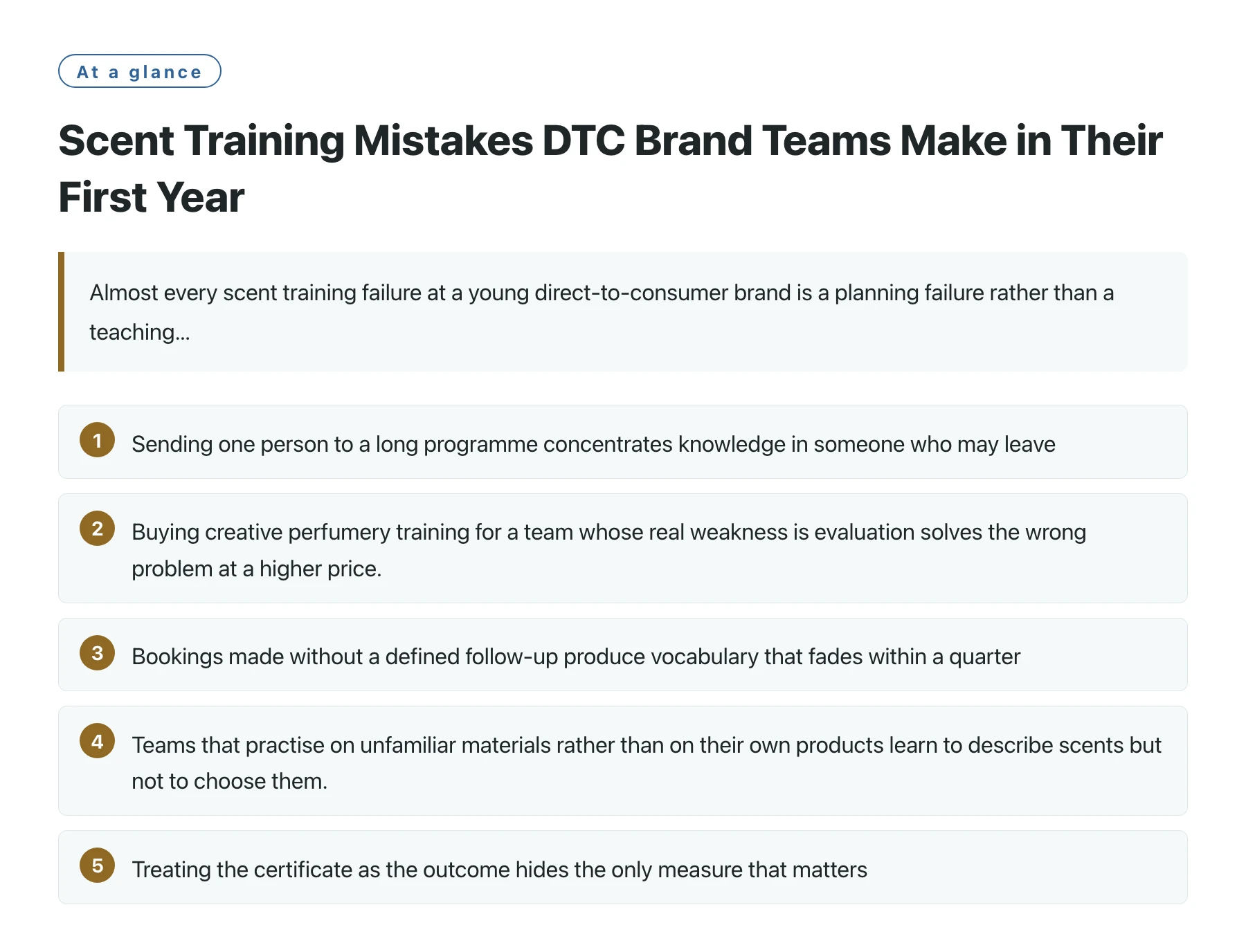
- Sending one person to a long programme concentrates knowledge in someone who may leave, while a short shared session changes how the whole team decides.
- Buying creative perfumery training for a team whose real weakness is evaluation solves the wrong problem at a higher price.
- Bookings made without a defined follow-up produce vocabulary that fades within a quarter, because nothing in the working week depends on it.
- Teams that practise on unfamiliar materials rather than on their own products learn to describe scents but not to choose them.
- Treating the certificate as the outcome hides the only measure that matters, which is whether the number of sample rounds falls.
The pattern usually starts well. A young brand decides it needs to understand scent properly, a founder books a respected course, and two people attend. The course is good. They come back with new vocabulary, a notebook of impressions and a genuine improvement in how they talk about materials. Six weeks later the next sampling round arrives, feedback is still split across three opinions, and nobody remembers which reference material was supposed to settle the argument.
Nothing in that story is unusual, and none of it is the course's fault. Training supplies a skill; a working habit is what keeps the skill alive, and habits have to be built into the week. The failures in this article all come from the gap between the two.
There is also a knowledge problem specific to this industry. Fragrance sits between chemistry, materials and commerce, and introductory material is scattered across supplier notes, museum interpretation and trade press. A team that understands how a perfumery material is described and classified will get more from any formal programme, because it will not spend the first day learning vocabulary it could have read [1]. That is a small argument for preparing before booking rather than hoping the course covers everything.
Six mistakes, and what to do instead
- Sending one person to a long programmeIndividual depth is valuable when the brand needs a specialist, but most small teams need a shared language more than a specialist. Send the people who argue about scent, and send them together, even if the programme is shorter. A a place to learn perfumery that runs team sessions rather than individual enrolments exists for exactly this reason.
- Buying composition training for an evaluation problemComposing a scent and judging one are different skills. A DTC team that learns to build an accord has bought a capability it will use once and maintain forever, while its actual weakness — ranking directions consistently — remains untouched.
- Booking without a follow-up decisionBefore paying, decide what happens in the thirty days afterwards: who runs the next evaluation, what reference materials are kept, and what the team will write down. Training without a scheduled application decays faster than almost any other purchase a small brand makes.
- Practising on exotic materials instead of your own productsA broad material set widens perception, which is useful, but the decisions your brand makes are about its own bottles, lotions and candles. Run every session against at least three products from your own range, or the learning will not transfer to the meeting where it matters.
- Treating the certificate as the outcomeThe certificate records attendance. The outcome worth measuring is the number of sample rounds per launch, the time taken to agree a direction, and how often a brief has to be rewritten. Track them before and after, and the value of the programme becomes visible rather than assumed.
- Leaving evaluation with no ownerIf nobody is responsible for holding the vocabulary and the reference set, the capability drifts back to whoever speaks loudest. Name a person, give them a small budget for materials, and put evaluation on their job description, not on their goodwill.
Why the mistakes repeat across brands
These errors share a cause: scent is treated as a taste rather than a process. A founder who would never approve a formula without a specification will happily approve a direction after a single sniff, because the product feels subjective. Suppliers respond to that, and the team that cannot rank consistently gets a development process that relies on the supplier's patience.
The correction is not to make scent objective, which it is not. It is to make the process around it disciplined: fixed evaluation conditions, a written vocabulary, a reference set, and one person accountable. Teams that do this find that their subjective judgement becomes more useful, not less, because disagreements narrow to genuine differences rather than to confusion.
It also changes what the brand asks a manufacturer for. A team with a defined evaluation process will request specific things — a graded set of directions, a base-specific test sample, a documented dosage change — and a competent manufacturer will recognise the request and answer it directly. That is a different relationship from asking what is possible.
The first-year budget question
A young brand rarely has a training budget, so the cost has to come out of development. That makes the opportunity cost concrete: a course is roughly the price of a sampling round, and it is worth buying instead of a round only if it prevents a later round from being wasted. Framing the decision that way is uncomfortable and clarifying.
It also argues for spending the first money on materials and habits rather than on travel. A modest kit, a written glossary and a monthly session can be funded from petty cash, and they make any later course more effective because the participants arrive with something to build on, such as a shared description of the material families they work with most [2].
What to look for in a partner's training
Suppliers occasionally offer sessions that are genuinely educational and occasionally ones that are a sales presentation with blotters. The difference is visible in the agenda. A useful session names the materials, allocates time to smell each one more than once, includes an exercise with a right and a wrong answer, and does not end with a catalogue.
It is also fair to ask how the session relates to production. Training that explains dosage, base and packaging behaviour, rather than only finished scents, is what helps a brand avoid the classic mismatch between a scent and its format. That is the kind of practical programme an an ODM partner for fragrance brands is in a position to run, because it lives with the consequences of the brief afterwards.
If the first year is tight, run one experiment before buying anything. Pick five materials, agree on ten words to describe them, smell the same five every month, and score your own products against them. Do it for a quarter and record how long it takes the team to agree on a direction. If the time falls, formal training will build on something real; if it does not, the problem is not knowledge and a course will not fix it. Brands that frame the purchase this way tend to get more from it, and they also ask better questions of the Xuelei perfume factory or any other manufacturer they end up working with.
A note on scale
None of this is an argument against training, and it is not an argument against depth. A brand that grows into a range of formats and a second market will eventually need a specialist who can hold a technical conversation, and that person needs a serious programme rather than a workshop. The mistake is buying that programme in the first year, for a team that is still learning to rank three directions.
The sequence that works for most small brands is habit, then shared vocabulary, then specialist depth. Each stage makes the next one cheaper, because participants arrive with relevant questions. It is also the sequence that keeps the cost proportionate to the revenue the capability is supporting, and it is the same sequence that makes a later conversation with a factory productive: Xuelei covers the other side of that relationship.
Sources
- Chemistry World (Royal Society of Chemistry) —— The Royal Society of Chemistry's magazine, covering chemistry research and explanations of everyday materials including aroma compounds.
- Wikipedia: Perfume —— An encyclopaedic overview of perfume covering definitions, history, the note structure of a fragrance and concentration terminology (background reference only).
Frequently asked questions
What is the single most common training mistake at a young brand?
Booking a course without deciding what the team will do differently afterwards. The course is often good and the participants often enjoy it, but with no scheduled evaluation session, reference materials or named owner, the new vocabulary stops being used within a quarter and the next sampling round looks exactly like the last one.
How many people should attend from a team of six?
Everyone who gives feedback on scent, which in practice is usually three or four people, plus whoever writes the brief. People who are not involved in scent decisions can be briefed afterwards. Sending the whole company is rarely useful and dilutes the shared session.
Is a shorter in-house session better than a longer open course?
For a first purchase and a team problem, usually yes. An in-house session can be built around your own products and your own disagreements, which makes the learning immediately applicable. A longer open course makes more sense once the team has a habit and one person needs to go deeper.
How do we measure whether the training worked?
Track three numbers before and after: sample rounds per launch, the time from brief to agreed direction, and the number of briefs that have to be rewritten. Improvement on those is evidence. A certificate and a positive feedback form are not, because they measure the day rather than the work.
Should we ask a manufacturer to train us if they also want our business?
It is reasonable, provided the session teaches transferable material knowledge and not a house catalogue. Ask for the agenda in advance and check that it covers how scents behave in different bases, since that knowledge is portable. If the agenda is a product presentation, treat it as a sales meeting rather than as training.
¿Listo para encontrar tu camino?
Unas sola sesión de 15 minutos, gratis y sin compromiso, puede cambiar tu próximo año.
Reserva tu sesión gratuita de 15 minutos